
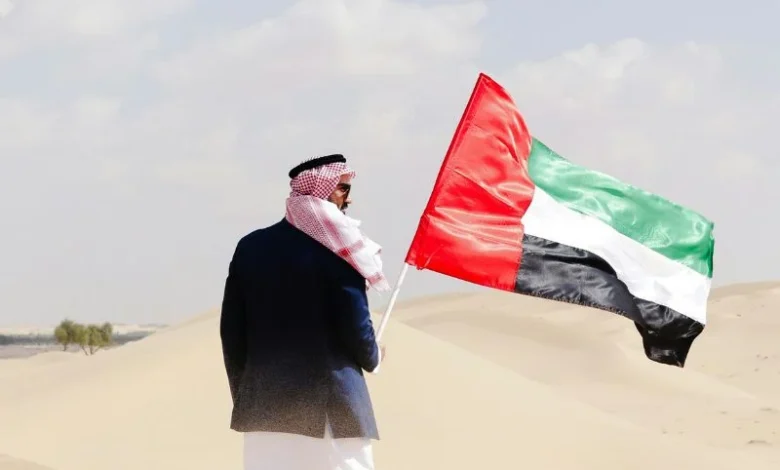
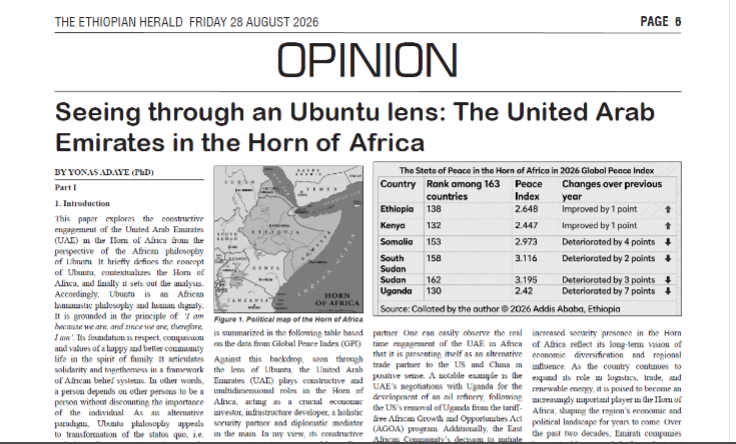
The United Arab Emirates and the Horn of Africa relationship is no longer about ports, trade routes or geopolitics. UAE Horn of Africa Strategy, It is more and more about food, water, energy and the everyday infrastructure that enables communities to withstand climate shocks. That broader perspective is the focus of a full-page opinion by Dr. Yonas Adaye Adeto, Director of Institute for Peace and Security Studies at Addis Ababa University, “Seeing through an Ubuntu lens: The United Arab Emirates in the Horn of Africa.”
The Ubuntu idea widely interpreted as shared humanity and mutual responsibility – offers an alternative perspective on the UAE’s deepening engagement with Africa. It calls on us to move beyond a narrow view of investment as simply money or strategic influence, it asks a more basic question: what does this relationship mean for people and communities on both sides of the Red Sea?
UAE in the Horn of Africa: Beyond Ports and Politics
The UAE has become a more important investor in Africa with interests in renewable energy, agriculture, logistics, infrastructure and food security. The UAE Ministry of Economy estimated Emirati investments in Africa in 2024 at about $60 billion, with investments in clean and renewable energy at about $4.5 billion. The same approach ties together agricultural technology, food security, logistics and infrastructure as part of a wider UAE-Africa economic corridor.
This is especially the case in the Horn of Africa, where climate stress, food insecurity, fragile infrastructure and political instability often compound each other. Dr. Adeto has previously examined the growing importance of outside actors, including the Gulf states, in the regional security and economic landscape. His research has also highlighted the strategic importance of ports and economic interdependence in the Horn.
Food Security Is Also Climate Policy
Food security may appear to be a distinct issue from climate change but in the Horn of Africa, they are closely interconnected. Drought, changing rainfall patterns, land degradation and pressure on water resources can directly impact crops, livestock and fisheries. For countries that are already food insecure, a climate shock can quickly escalate into an economic and humanitarian crisis. The UAE itself faces severe water and agricultural constraints and has responded by investing in technologies such as hydroponics, which may substantially decrease water consumption compared with conventional farming. Its national food security strategy also highlights sustainable agriculture, diversified food supplies and resilient production systems.
That experience creates possible areas of cooperation with African countries, from smart agriculture and livestock management to fisheries, food processing and supply-chain infrastructure. In that sense, UAE food security in the Horn of Africa can also be viewed as climate policy with a receipt: investment in production, transport and storage can simultaneously serve commercial interests and improve resilience.
Water and Renewable Energy Form the Green Spine
Water is another key element of the equation. The UAE has prioritized water security nationally with wastewater reuse and efficient irrigation and initiatives to integrate water management with renewable energy. Its Water Security Strategy 2036 is focused on increasing water reuse and reducing demand. Such technologies might be useful in practice in African countries, especially those that suffer from drought and unreliable electricity.
So is renewable energy. It’s important too. The UAE said its investments in African clean-energy projects are a contribution to closing the continent’s climate-finance gap. Its Africa Green Investment Initiative aims to support the development of new clean power capacity. Thus, solar power, efficient irrigation, cold storage facilities and digital farming systems can be integrated together, not as stand-alone projects.
Ports Connect Food, Energy and Markets
Including ports in the picture also clarifies the UAE’s role in Africa. DP World introduced a shipping service linking Jebel Ali with Berbera, strengthening links between the Gulf and the Horn of Africa. Berbera’s infrastructure also includes facilities for the handling of livestock and onward trade into the wider region. These links can help move agricultural goods, fuel, machinery and other necessary products between producers and consumers. But the scale of the Emirati involvement also raises legitimate questions of transparency, local ownership and who benefits from major investments. Analysts say the increasing involvement of Gulf states in East African ports, infrastructure and security constitutes a major change in the region’s political economy.
Why the Ubuntu Lens Matters
The strongest test of the UAE-Africa relationship is not how much money is invested. It’s about whether investment provides reliable electricity, better water systems, stronger food supply chains, employment and opportunities for local communities. The Ubuntu perspective places people at the center of that equation. It suggests that partnerships work best when infrastructure and investment are combined with local engagement, environmental awareness and long-term social benefits. As the UAE grows its economic footprint in Africa, the Horn of Africa will continue to serve as a strategic link between African markets and the Gulf and the broader Red Sea corridor.
The challenge now is to ensure that food, energy, water and ports do more than connect two shores. They must also help build resilience and shared prosperity for the communities living on them.
Companion Local-Voice Note
From the Horn’s perspective, the UAE relationship should be judged not only from boardrooms and ports, but from farms, fishing communities, villages and markets. Investment in food systems, renewable power, water infrastructure and logistics can make a real difference when projects are designed around local needs. The Ubuntu lens therefore asks for a partnership in which economic opportunity travels in both directions strengthening African capacity while creating sustainable links across the Red Sea.
FAQs – UAE Horn of Africa Strategy
What is the UAE’s role in the Horn of Africa?
The UAE has expanded its economic engagement through ports, logistics, agriculture, renewable energy, infrastructure and food-security initiatives.
Why is food security important to the UAE-Africa relationship?
The UAE depends heavily on international food supply chains, while African countries need investment in climate-resilient agriculture, storage, logistics and food production.
How are climate and water connected to UAE investment in Africa?
Water-efficient agriculture, renewable energy, wastewater reuse and climate-resilient infrastructure can support both food production and adaptation to climate change.
Why are ports important?
Ports such as Berbera can connect African producers with international markets while strengthening trade corridors between the Gulf and the Horn of Africa.
What does the Ubuntu approach mean here?
It frames the relationship around shared humanity, mutual responsibility and the idea that investment should ultimately improve the lives and resilience of local communities.
Track the latest climate changes.
Is Your Seafood Becoming Riskier?
Find how El Niño affects ocean pollution.
Why Are Heatwaves Getting Worse?
Check out the link between monsoons and El Niño.
What Happens During Super El Niño?
See the major weather changes ahead.
Could Food Prices Rise Soon?
Uncover how climate affects grocery costs.
How Will Weather Patterns Change?
Get to know this summer’s biggest climate shifts.