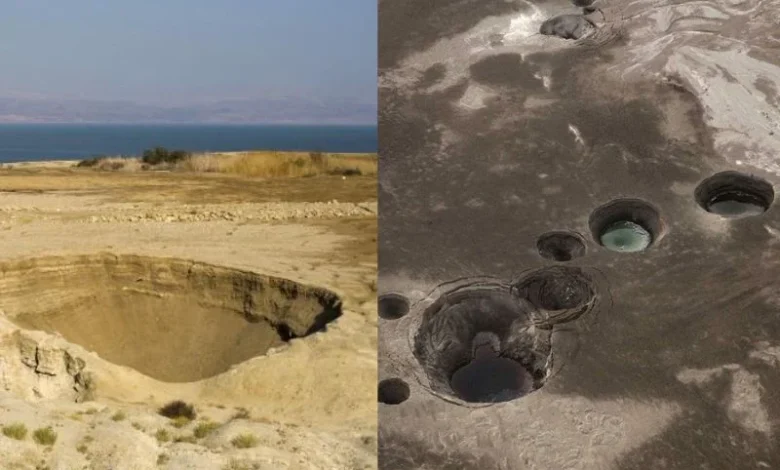
The Dead Sea sinkholes are not a rare curiosity anymore. They are a fast-moving hazard reshaping one of the world’s most famous natural landmarks. Along both the Israeli and Jordanian shorelines, the ground is literally collapsing, sometimes without warning, and the number of holes keeps climbing every year.
What Exactly Is Happening at the Dead Sea
The Dead Sea has been shrinking for decades. Its water level drops by roughly one metre a year, largely because upstream countries divert water from the Jordan River for farming and drinking supplies. As the shoreline retreats, it leaves behind land that looks solid but is dangerously hollow underneath.
The Real Cause Behind the Sinkholes
Here is the simple version of the science. Thousands of years ago, a thick layer of underground salt formed near the coast. While the sea was full, salty brine kept that layer stable. As the water retreats, fresh groundwater from nearby mountains reaches this layer instead.
Fresh water dissolves salt far more easily than brine does. This process eats away at the salt from below, carving out underground caverns. Eventually the ground above cannot hold its own weight, and it caves in, forming a sinkhole.
Researchers have tracked more than a thousand sinkholes along the western shore alone, with well over a hundred new ones appearing every year, mostly clustered along old fault lines in the Jordan Rift Valley.
Why This Matters Beyond the Middle East
This is not just a local story. It shows what happens when a major body of water disappears faster than nature can adjust.
- Tourism impact: Beaches such as Ein Gedi have been abandoned because nearby ground is unsafe
- Infrastructure risk: Roads, pipelines and old buildings have already been swallowed or damaged
- Farmland loss: Land in Jordan’s Ghor Haditha area has been destroyed by expanding holes
- Economic strain: The region’s mud and mineral industry, valued worldwide in cosmetics, faces growing disruption
Checklist: Staying Safe Near Sinkhole Zones
- Stick to marked, officially maintained paths and beaches
- Avoid walking on cracked, damp, or freshly settled ground
- Never lean over a sinkhole edge for photos; edges crumble easily
- Follow local tourism authority signage across Israel, Jordan and the West Bank
- Check recent travel advisories before visiting remote shoreline stretches
Conclusion
The Dead Sea sinkholes are a warning sign of what happens when a water body shrinks faster than nature can keep pace. Fixing the root cause will need genuine regional cooperation on water sharing. Until that happens, respecting marked boundaries remains the simplest way to enjoy this remarkable landscape safely.
Track the latest climate changes.
Is Your Seafood Becoming Riskier?
Find how El Niño affects ocean pollution.
Why Are Heatwaves Getting Worse?
Check out the link between monsoons and El Niño.
What Happens During Super El Niño?
See the major weather changes ahead.
Could Food Prices Rise Soon?
Uncover how climate affects grocery costs.
How Will Weather Patterns Change?
Get to know this summer’s biggest climate shifts.