Why Mangrove Roots Are Becoming Nature’s Secret Weapon Against Killer Storm Waves

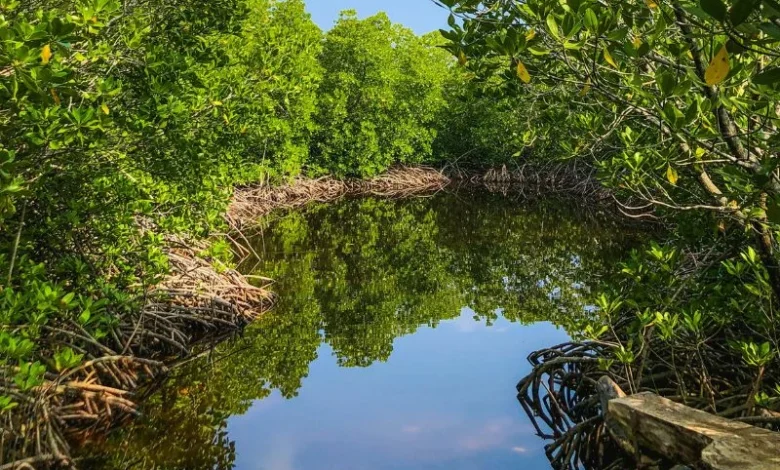
Walk along almost any tropical coastline and sooner or later you’ll run into a thick tangle of mangroves standing guard between the open sea and the nearest village. predict mangrove wave protection, People there have leaned on these trees for generations, trusting them to take the edge off a bad storm. The problem was, nobody could put a solid number on just how much protection that actually meant. Now scientists have found a way to predict mangrove wave protection using real measurements instead of rough guesses, and it might change how coastal towns get ready for the next storm season.
How Mangroves Actually Slow Down a Wave
The fact that mangroves protect from storm waves is nothing new to anyone who lives near them. What’s new is understanding exactly how it happens. A wave moving toward land doesn’t just pass through a mangrove stand undisturbed, it has to push past thousands of tightly packed roots and trunks, and that constant friction eats away at its strength. Researchers tracking a typhoon along China’s Zhanjiang coast caught this in action, recording waves nearly three feet tall entering the forest edge. After travelling roughly the length of a football field through the roots, those same waves had shrunk to under one and a half feet. Over the full storm season, the forest knocked wave height down by somewhere between 44 and 70 percent. For a family living just behind that tree line, that gap could be the difference between a wet doorstep and a flooded living room.
A Calculation Simple Enough to Use Anywhere
Working out how much protection a stretch of mangrove actually gives is used to take a mountain of data, plant density, trunk width, water drag, turbulence, and more. Most local authorities just don’t have the money or manpower for that kind of fieldwork. So the research team built something far more practical, a method they call the HU wave formula, which only needs two numbers to work, a wave height measurement and something called the Ursell number. When tested against real typhoon conditions, it matched what actually happened far better than the older, more complicated models ever did.
A Free Online Tool for Planners and Communities
The scientists didn’t stop at publishing a formula. They also built an online attenuation calculator so that people without a science degree, local officials, engineers, restoration workers, could enter their own wave data and get a usable answer back. It’s already proving useful for things like:
- Working out how wide a new mangrove planting should be
- Deciding whether a concrete sea wall is really needed on top of natural cover
- Helping disaster management offices prepare ahead of cyclone season
- Giving fishing and farming families a clearer sense of their flood risk
Governments across Southeast Asia, South Asia, East Africa and the Pacific islands could fold this straight into coastal plans and mangrove restoration schemes already running in many of these places.
Where the Science Still Has Gaps
To be fair, this method has only been tested at one site so far, and mangroves that end up fully underwater during extreme high tides might not behave the same way. The team behind the published climate risk study is upfront about this, saying more testing across different coastlines is needed before anyone calls this a finished, ready-to-go planning tool. When the stakes involve people’s homes and lives, that kind of caution is worth respecting.
Conclusion – predict mangrove wave protection
Storms show no sign of easing up, and coastal communities need defenses they can actually afford and rely on. This new way of measuring mangrove protection hands planners, local officials and everyday coastal residents a tool that doesn’t need a big budget or a university lab behind it. Keeping mangroves standing right now might turn out to be one of the simplest, cheapest ways to keep people safe later.
Wildlife stories worth watching closely.
Which Countries Face Wildlife Loss?
Check out global hotspots where endangered species need urgent protection.
What Makes This Monkey So Rare?
Find out about the newly discovered orange-lipped monkey in Congo.
Why Are Andaman Species Disappearing?
Uncover why these unique species need immediate conservation efforts.
Can AI Help Save Wildlife?
See how AI is transforming endangered wildlife monitoring.
Which Species Are Near Extinction?
Look into wildlife facing the highest risks of disappearing.