New Crocodile Species Named After Egyptian God Found in Rock Used to Build the Sphinx

Palaeontologists have confirmed a new extinct crocodile species in Egypt, and it is making headlines far beyond the usual science circles. The animal belonged to the same family as the gharial, the narrow-snouted crocodile that still survives today in a handful of South Asian rivers. For people in Pakistan, where gharials once lived in the Indus and are now barely clinging on, this story adds a surprising new branch to the family tree of an animal many assume is purely a South Asian creature.
What Was Actually Found
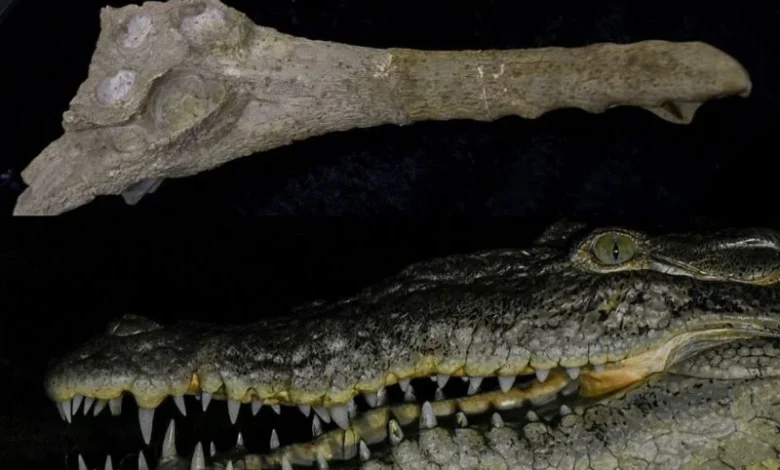
The fossil itself is not new. It was dug up back in the 1920s from a rock layer near Cairo called the Mokattam Formation, the same quarry that supplied stone for the Sphinx of Giza. For decades it sat in collections, filed under a different crocodile group called Tomistoma. It was only when researchers scanned the skull using CT imaging that the differences became obvious, and the fossil was reclassified as a new species.
Why the Name Herugavialis
The team named the species Herugavialis cairensis, after Heru, better known to most people as Horus, the falcon-headed Egyptian god. The tip of the skull’s snout is broken off and missing, which gave the fossil a flattened, almost sphinx-like profile when the scientists examined it, and that similarity reportedly inspired the name. The full details of how the skull was studied are laid out in the research paper itself.
How It Connects Back to the Gharial
Today there are only two gharial-type crocodiles left on Earth: the true gharial found in North India and once native to Pakistan’s Indus river system, and the false gharial of Southeast Asia. But the fossil record tells a very different story. Gharial relatives once lived across nearly the entire planet for more than 100 million years, and many of them were not river animals at all. They lived in shallow coastal seas, which is exactly where Herugavialis cairensis spent its life.
Why This Should Matter to Readers in Pakistan
Pakistan’s own gharial population has shrunk drastically, and sightings along the Indus are now rare enough to make news when they happen. A find like this is a useful reminder that the gharial is not some minor regional species. It is the last living thread of a family that once stretched from Egypt to the Bay of Bengal.
Quick Facts
- Species: Herugavialis cairensis
- Age: roughly 45 million years old, from the Middle Eocene
- Found: Mokattam Formation, near Cairo, Egypt
- Family group: same as the modern gharial
- Study published: October 2026, in an international peer-reviewed journal
- Research team: scientists from Sweden, the UK, Germany and Egypt
Researchers also found that at least two other gharial relatives shared the same ancient Egyptian seas as Herugavialis. Their numbers rose and fell with sea level and global temperature changes over millions of years, before crocodiles disappeared from the Mediterranean region altogether around six million years ago.
Conclusion – Extinct Crocodile Species
This discovery shows that the endangered gharial swimming in a handful of rivers today is really the last survivor of a once-massive family that ruled ancient coastlines across continents. For anyone in Pakistan following wildlife news, it is a quiet reminder that saving the gharial is also about protecting one of the oldest reptile bloodlines on the planet.
Stay informed on nature’s biggest global events.
How Active Is Russia’s Volcano?
Find out what triggered this rare volcanic eruption after the powerful earthquake.
Could Japan Face Another Disaster?
Dive into Japan’s ongoing efforts to tackle earthquakes and volcanic threats.
Is Vanuatu Safe To Visit?
Check out the latest travel guidance after the recent major earthquake.
Why Is The Ozone Recovering?
Uncover what the smaller Antarctic ozone hole means for the environment.
How Vital Is Ayeyarwady River?
Look into why protecting Myanmar’s lifeline is crucial for communities and nature.