
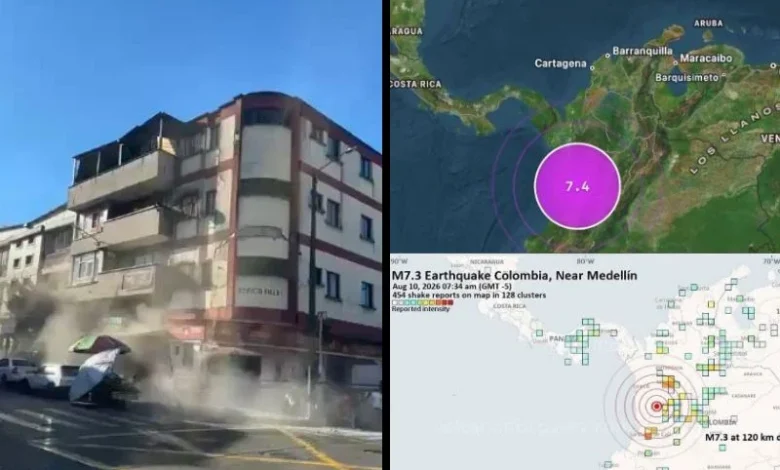
A powerful Colombia earthquake struck western Colombia on Monday, August 10, 2026, and the country is now facing one of its worst natural disasters in decades. The 7.4-magnitude quake hit early that morning near San José del Palmar, and as rescue teams enter a second day of digging through collapsed buildings, officials warn that the confirmed death toll will likely keep climbing.
What Happened and Where
The quake struck Colombia’s coffee-growing heartland on August 10, an area known more for its scenic hills than seismic danger. It hit hardest in Cali, Pereira and Manizales, three major cities that together are home to millions of people. In Cali alone, home to roughly 2.2 million residents, at least 85 people have died. Pereira, capital of Risaralda state, reported 66 deaths, with entire residential blocks reduced to concrete and twisted steel. A historic cathedral tower in Manizales also cracked apart during the shaking.
Why the Death Toll Keeps Rising
By August 11, search and rescue operations had entered their second day, and this is often when the death toll jumps sharply. Many people remain trapped under rubble, and rescue workers, soldiers and ordinary volunteers are digging by hand in places heavy machinery cannot reach. One devastating detail from Cali: the pediatric and neonatal sections of a hospital collapsed on the day of the quake, trapping patients and forcing hundreds of people onto the street outside.
This pattern is familiar from past disasters. The first 48 to 72 hours after an earthquake are critical for finding survivors alive, and that window is now closing, which is why officials are being upfront that the numbers will grow further.
How the World Is Responding
Newly inaugurated President Abelardo de la Espriella, who took office just two days before the quake, has personally taken charge of the emergency response and declared a national disaster. International support has poured in quickly since August 10:
- The United States has pledged to closely monitor the situation and support relief efforts.
- The European Union has activated its Copernicus satellite service to assist search operations.
- Neighboring countries including Mexico and El Salvador have offered direct aid.
- The Red Cross is receiving EU funding to expand its ground response.
A Region With a Painful History
For many Colombians, this disaster echoes a deadly 1999 earthquake that struck the same coffee-growing region and killed more than a thousand people. It also follows a catastrophic quake in neighboring Venezuela earlier this year that killed thousands, a grim reminder that this part of South America sits on genuinely dangerous fault lines.
What Comes Next
As of August 11, over 160 people have been confirmed dead, with hundreds more injured or unaccounted for. Around 1,600 buildings across the affected region have been reported damaged or destroyed. Recovery will likely take months, if not years, particularly in poorer rural areas like Chocó, where communication outages have slowed both rescue efforts and accurate casualty counts.
Conclusion
One day after the quake, Colombia is a stark reminder that even regions not typically associated with major seismic events can be struck without warning. As the country mourns its losses and continues digging through the rubble on this second day of search and rescue, the immediate priority remains simple: finding anyone who can still be saved.
Stay informed with related updates.
Is Vanuatu Safe To Visit?
Check out the latest travel advice after the earthquake.
Why Is Bhutan Seismically Active?
Find the reasons behind frequent Himalayan earthquakes.
What Triggered Russia’s Volcano Eruption?
Uncover how earthquakes may have sparked the eruption.
Can Climate Trigger More Earthquakes?
Look into the science behind this growing question.
Why Are Fuego Residents Evacuating?
See why authorities ordered communities to move.