
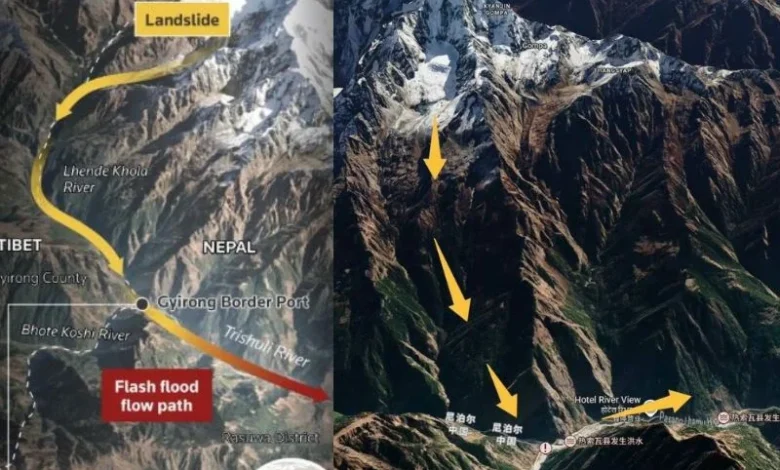
It happened in minutes. A peaceful mountain valley on the Nepal-Tibet border turned into a scene of total destruction on Wednesday morning. The Nepal-Tibet border flood tore through bridges, homes, and roads near Nepal’s Rasuwa district and Tibet’s Gyirong County. Rescue crews are still combing the debris for missing travellers, among them tourists from India, South Korea, and a handful of other countries.
What Actually Caused the Flood
The first theory pointed to an earthquake. A magnitude 4.4 tremor was picked up near the border, and Nepali officials initially said this had set off the flooding.
That explanation didn’t hold up under scrutiny, though. Geologists who reviewed satellite images now think a massive chunk of ice broke free from a glacier sitting high above the valley and plunged more than a kilometre down. This is what’s called an ice avalanche, and it’s probably what created the seismic tremor everyone first mistook for an earthquake. The ice and rock slammed straight into the Lhende Khola river, blocking it for a short while before the makeshift dam gave out and unleashed a torrent of mud and debris downhill.
Why This Keeps Happening in the Himalayas
This isn’t a one-off tragedy. The Himalayas are warming, and their glaciers are melting and cracking apart faster than they used to. The same Rasuwa region saw a similar glacial lake burst just last year.
A few reasons this region keeps getting hit:
- Warmer temperatures are weakening glacier ice, so sudden breaks are becoming more common.
- Meltwater pools that sit on top of glaciers, called supraglacial lakes, can rupture with almost no warning.
- The terrain is so remote that monitoring it properly is a real challenge.
- Villages downstream often get little or no time to react before the water arrives.
Where Things Stand Now
Rescue helicopters still can’t land near the disaster site because floodwaters and thick sediment are blocking the way in. Officials have also warned that a second flood could still hit, since a chunk of debris remains stuck upstream. Flood alerts have gone out in India’s Bihar and Uttar Pradesh states too, since several rivers flowing down from Nepal end up in those plains.
A Wake-Up Call for the Region – Nepal-Tibet border flood
What happened this week is a hard reminder that a warming climate is changing the Himalayas in ways that put entire communities at risk. Stronger early warning systems, along with real cooperation between Nepal, China, and India, will matter more with each passing year.
Read more Climate Changes:
Which Hyderabad areas face worst heat?
Check the neighborhoods most vulnerable during extreme heatwaves in the city.
Which Indian cities face extreme heat?
Discover the regions across India at highest risk from rising temperatures.
Is major weather shift coming April?
Explore how upcoming weather changes could impact temperatures across India.
Which cities face climate risk 2026?
Check the urban areas under immediate environmental threat this year.
Why Chennai preparing early for heat?
Discover how Chennai is tackling rising temperatures and health risks early.