

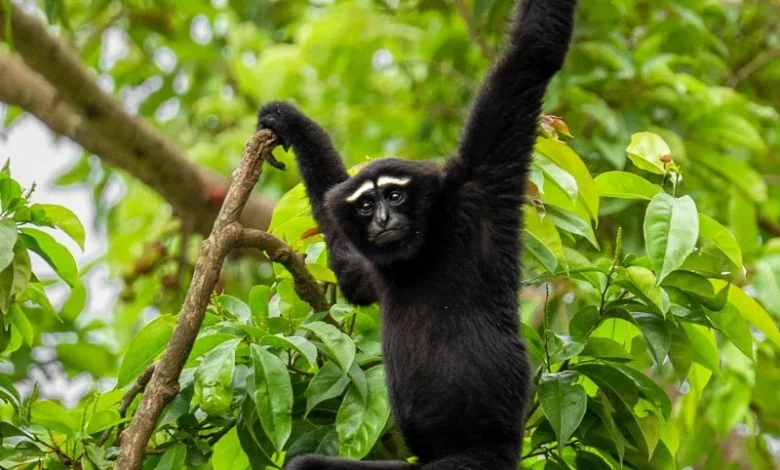
Hidden away in the dense forests of Assam and adjoining states is a creature that most of the world has never heard of, but its voice travels for kilometers every morning. The hoolock gibbon, Hoolock gibbon assam, India’s only ape, announces itself not with a roar but with a haunting musical duet that has reverberated through these forests for generations.
Why This Little Primate Is a Big Deal
Most of us think of apes as the giants of Africa, the gorillas and chimpanzees. None of these are in India. The only representative is the much smaller hoolock gibbon, which is found only in the northeastern states of Assam, Arunachal Pradesh, Nagaland, Meghalaya, Manipur and Mizoram. Gibbons have no tail, unlike monkeys, and their arms are longer than their legs. This is all by design, and for one purpose only: to swing through the canopy at astonishing speeds.
The song that made the monkey famous
Each morning a mated pair calls out together in a rising, rhythmic duet that can last fifteen to twenty minutes. This is not random noise. The gibbon’s song delineates their territory and intensifies the pair bond, and in some rural areas of Assam, older people used to count the hour of the day by the rhythm of these calls as a kind of natural clock.
The Swing of Its Movement
Gibbons rarely come to the ground. They move by brachiation, hand over hand, swinging from branch to branch and sometimes covering over ten meters in a single motion. This combination of acrobatic ability and striking color change (males remain black, while females turn golden buff as adults) makes them one of the most visually distinctive animals of the forests of India.
Why the Gibbon Is Struggling Today
• Declining forest cover in the Northeast: loss of habitat.
• Fragmentation by roads, tea estates and settlements.
• Small, isolated populations with limited opportunities for breeding.
• Hunting in some tribal areas, mostly now historical.
A Species to Protect – Hoolock gibbon assam
Seeing or even hearing a hoolock gibbon is a rare treat for visitors and locals alike. Sanctuaries like the Hollongapar Gibbon Wildlife Sanctuary near Jorhat are dedicated to the protection of the species, and community efforts in villages such as Barekuri prove that people and gibbons can live together if the local people decide to protect the trees around their homes.
The hoolock gibbon is not just a zoological curiosity. It is a living reminder that there are sounds and stories in India’s forests that the world has barely begun to notice, and to protect them we must first know they are there.
More Wildlife Adventures Await!
Why Visit Kaziranga National Park Today?
Discover why this iconic park is a paradise for wildlife lovers.
How Are Greece’s Wildfires Changing Nature?
Find out how wildfires are reshaping Mediterranean ecosystems.
What Makes Kerala’s Backwaters So Wild?
Dive into the rich birds, mangroves, and aquatic life thriving here.
Which Mongolia Parks Protect Rare Species?
Uncover hidden national parks preserving unique desert wildlife.
Which Kenya Safari Should You Experience?
Browse the top wildlife safaris for unforgettable nature encounters.