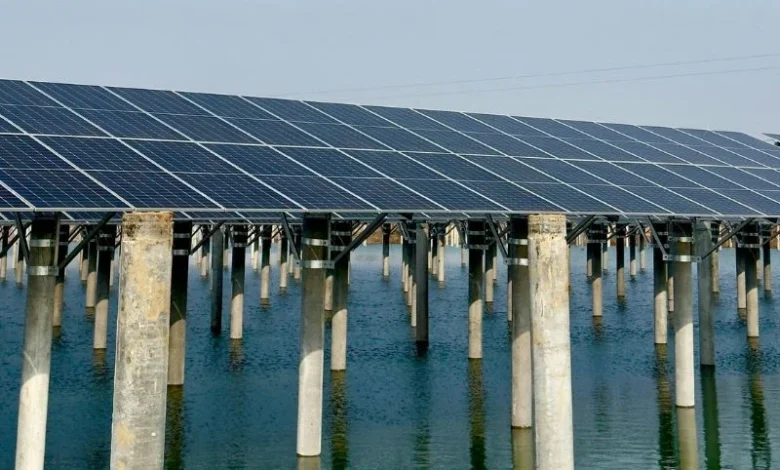
Floating solar utilizes lakes and reservoirs for solar panel installations as opposed to land. This usage conserves land, and the water cools the panels in the process. However, in terms of the installed capacity, it still remains below 10 GW as compared to over 1,000 GW for on-ground solar installations.
How Does It Work?
The solar panels sit on floats that are equipped with inverters either on site or on shore. Using water for cooling improves energy output while shading reduces evaporation. According to studies, evaporation is lowered by an astonishing number of up to 40%.
India’s Push
- Omkareshwar: This is where the biggest project, with a capacity of 600 MW is located in a reservoir in Madhya Pradesh.
- Potential: The floating solar power potential is estimated to reach from 102 GWp when only 20% of the surface of a reservoir is utilized, to 206–280 GW.
- Today: It has been established that India has about 0.7 GW installed, and SECI plans to install 5,000 MW.
What Are the Catches?
Experts have noted difficulties such as the choice of location, environmental impact, regulations and funding. Environmental issues include the shading over aquatic habitats, impact on fish and water quality. Equipment also wears down through waves, moisture and corrosion.
The Worldwide Picture
Global capacity was around 9.6 GW in 2024 with annual additions around 1–1.2 GW driven by China, India, South Korea and Japan.
Stay informed on nature’s biggest global events
Can Renewables Deliver a Greener Future?
Weigh the promise and the limits.
How Do Communities Fight Drought?
Meet the volunteers in Hungary building their own dams.
Will Countries Hit Food Goals?
Find out why most may miss 2030 targets.