

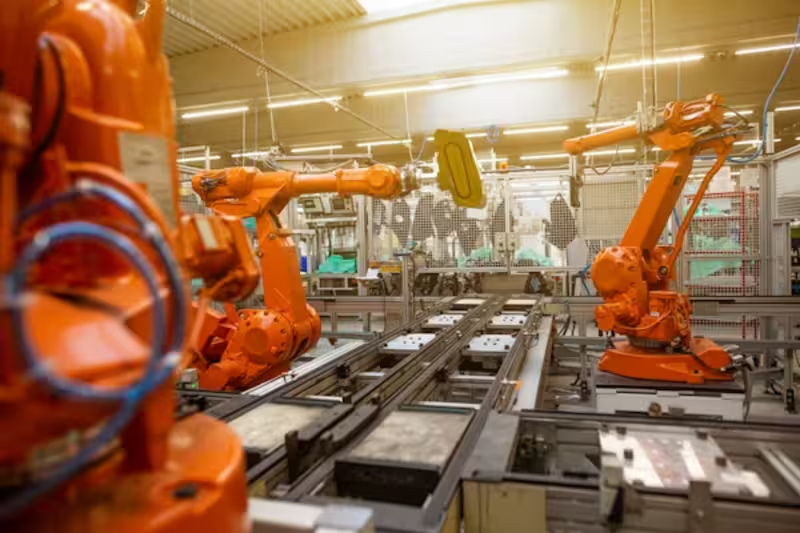
Manufacturing is entering a new era driven by digital technology, automation, and artificial intelligence. Often referred to as the Fourth Industrial Revolution or Industry 4.0, this transformation is changing how factories design, produce, and deliver products. Companies are adopting smarter systems to improve efficiency, reduce costs, and increase production quality.
1. Artificial Intelligence (AI)
AI helps manufacturers predict equipment failures, improve quality control, optimize production schedules, and automate repetitive tasks.
2. Industrial Robots
Modern robots can assemble products, weld components, package goods, and perform precision tasks faster and more accurately than ever before.
3. Internet of Things (IoT)
Connected sensors collect real-time data from machines, allowing manufacturers to monitor equipment, reduce downtime, and improve productivity.
4. 3D Printing
Also known as additive manufacturing, 3D printing enables companies to create prototypes and customized parts quickly while reducing material waste.
5. Digital Twins
A digital twin is a virtual model of a machine or factory that helps engineers test improvements, monitor performance, and identify problems before they occur.
6. Cloud Computing
Cloud platforms allow manufacturers to store, analyze, and share production data securely across multiple locations, improving collaboration and decision-making.
7. Autonomous Vehicles
Driverless forklifts, warehouse robots, and automated guided vehicles (AGVs) are improving the movement of materials inside factories and distribution centers.
8. Augmented Reality (AR)
AR helps workers with equipment maintenance, assembly instructions, and employee training by displaying digital information over real-world objects.
9. Advanced Analytics
Manufacturers use data analytics to identify production trends, reduce waste, improve quality, and make better business decisions.
10. Renewable Energy Integration
Many factories are installing rooftop solar panels, battery storage systems, and energy-efficient equipment to reduce operating costs and lower carbon emissions.
Why It Matters
These technologies help manufacturers:
- Increase productivity
- Improve product quality
- Reduce operating costs
- Minimize downtime
- Enhance worker safety
- Lower energy consumption
- Build more resilient supply chains
Conclusion
The new industrial revolution is transforming manufacturing through smarter machines, connected factories, and data-driven decision-making. As technologies like AI, robotics, IoT, and digital twins become more common, manufacturers will be able to produce goods faster, more efficiently, and with greater flexibility. Businesses that embrace these innovations will be better positioned to compete in the global economy.
FAQs
What is the Fourth Industrial Revolution?
It is the integration of digital technologies such as AI, automation, and IoT into manufacturing and industry.
How does AI help manufacturers?
AI improves production planning, quality control, predictive maintenance, and operational efficiency.
What is a digital twin?
A digital twin is a virtual replica of a physical machine or system used for monitoring and testing.
Why is IoT important in manufacturing?
IoT sensors provide real-time data that helps improve machine performance and reduce downtime.