
Saharan Desert Winds Fertilize the Amazon Basin: The Dust That Feeds a Rainforest
Discover how Saharan dust fertilizes the Amazon rainforest with phosphorus, sustaining its ecosystem and supporting Earth's climate through nature's cycle. Learn!

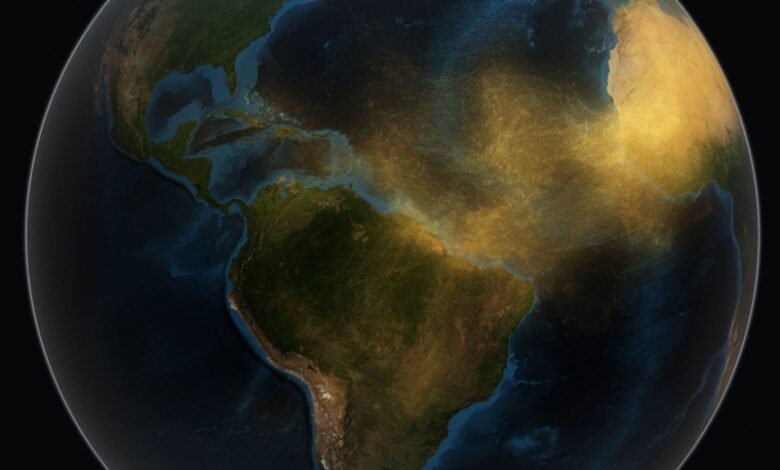
Two continents, two opposing landscapes, one shared secret. The driest desert on Earth quietly feeds the wettest rainforest on Earth. And it does so with nothing more than wind and dust. It sounds unlikely, but it’s one of the most remarkable natural partnerships on earth.
Saharan Dust’s Journey to South America
Every year, powerful winds blow enormous clouds of sand and dust from the Sahara Desert across the Atlantic Ocean for about 10,000 kilometers. Much of this dust comes from an ancient lakebed in Chad and is rich in phosphorus. Scientists found that NASA satellite data show the Sahara sends about 27 to 28 million tonnes of dust across the Atlantic each year, much of it settling in the Amazon basin.
Why Dust Needs Amazon
It sounds weird that the largest rainforest on earth needs help from a desert, but it’s true; the soil of the Amazon is naturally nutrient-poor. Amazon soils are not rich in nutrients, which are stored in living plants rather than in the ground itself. Most nutrients come from fallen leaves and organic matter, but rainfall continually washes phosphorus into the rivers, draining the basin like a slowly leaking bathtub.
This is where the Saharan dust comes into play. Phosphorus from Saharan dust reaching Amazon soils, estimated at about 22,000 tonnes a year, is roughly equal to the amount lost to rain and flooding. In fact, the desert makes up for what the rainforest loses.
What to Do When Phosphorus Is Too Low
Phosphorus is not to be sneezed at. In a field experiment in 2022, adding phosphorus to an old-growth Amazon forest on low-phosphorus soil led to a 29% increase in fine-root growth and a 19% increase in canopy growth in two years. That’s how directly the health of the forest depends on this one nutrient coming from thousands of kilometers away.
Why This Balance Is Important Globally
•The Amazon is soaking up tremendous amounts of carbon dioxide so it’s important to the climate of the entire planet, not only South America.
•Interannual variation in dust production, and hence dust deposition, is related to Sahel rainfall and has a lagged relationship with earlier Sahel rainfall.
•If the desert conditions or the Atlantic wind patterns change, this nutrient supply could be quietly disrupted.
•Air quality along the path of the dust, including the Caribbean and southern United States, is also affected during peak dust season.
An Ancient, Delicate System
This exchange has probably been going on for thousands of years, largely unnoticed until satellites made it visible. It is a reminder that ecosystems thousands of miles apart are often linked in ways we cannot see from the ground.
Conclusion
The Sahara and the Amazon seem to be polar opposites but no-one can live without the dust from the other. That delicate cross-continental balance matters not only to the regions directly involved but to the entire planet.
More climate stories to explore.
How Is Ladakh Changing Fast?
Check out how climate change threatens its historic architecture.
Why Are Animals Moving Away?
Find how climate change is reshaping wildlife migration.
Could Permafrost Worsen Climate Change?
Uncover why melting Arctic ground is a growing concern.
Can Kids Change Climate Policies?
See how youth lawsuits are influencing climate action.
Why Are Digital Climate Strikes Growing?
Browse how online activism is reshaping environmental protests.