
Earth’s Risk Meter Spikes: Doomsday Clock at 85 Seconds to Midnight
With the Clock now at 85 seconds to midnight, scientists cite climate disruption and nuclear strain as key drivers. The update highlights growing global instability.

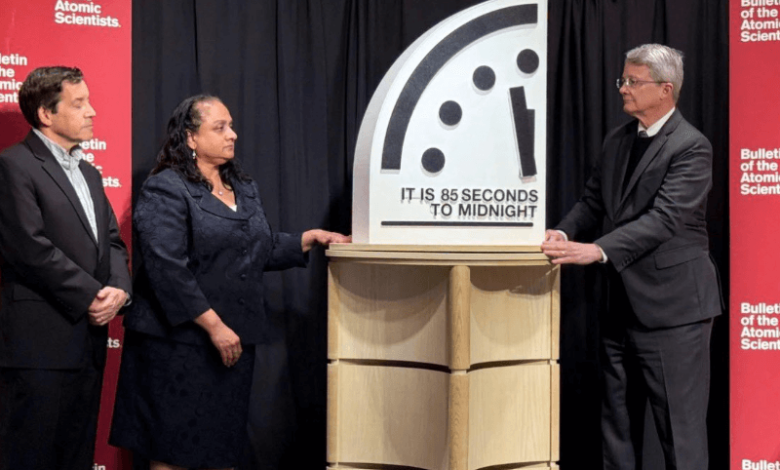
The Doomsday Clock just moved closer than ever: 85 seconds to midnight. The Bulletin of the Atomic Scientists says it’s a warning flare, not a prediction, reflecting how fast today’s risks can stack and cascade.
Why Scientists Say The World Is Sliding Toward The Brink
Announced on January 27, 2026, the new setting points to intensifying nuclear tensions, wars that could widen, and weakening arms-control guardrails, with New START nearing expiry. The Bulletin and reporting on the announcement also flagged flashpoints including the Russia–Ukraine war, conflict in the Middle East, and rising pressure around Iran and Taiwan as part of a broader “great-power” drift toward confrontation.
Climate is not treated as a separate lane. The Bulletin notes record warmth, rising seas, and a more erratic hydrologic cycle, where deluges and droughts bounce across regions and strain governments already dealing with security shocks. Here’s the post the Bulletin shared alongside the update.
The New Risk Multiplier: AI, Biosecurity, And Information Chaos
Beyond nukes and heat, the 2026 statement leans hard on “disruptive technologies.” It warns that fast-moving AI can amplify disinformation and speed up military decision loops, while AI-aided biology could help design pathogens. It even points to research concerns around “mirror life” as a potential high-consequence bio risk if mishandled.
What The Bulletin Wants Next
The Board urges leaders to restart serious nuclear dialogue, avoid destabilising steps like renewed explosive testing, and set international rules for AI in military and nuclear command-and-control. On climate, it calls for rapid cuts in fossil-fuel dependence, plus resilience investments that keep disasters from turning into political and humanitarian spirals.